Shopify Storefront MCP: A Merchant Guide to AI Shopping
Learn how Shopify Storefront MCP and UCP help AI agents search products, answer policy questions, manage carts, and connect shoppers to checkout.
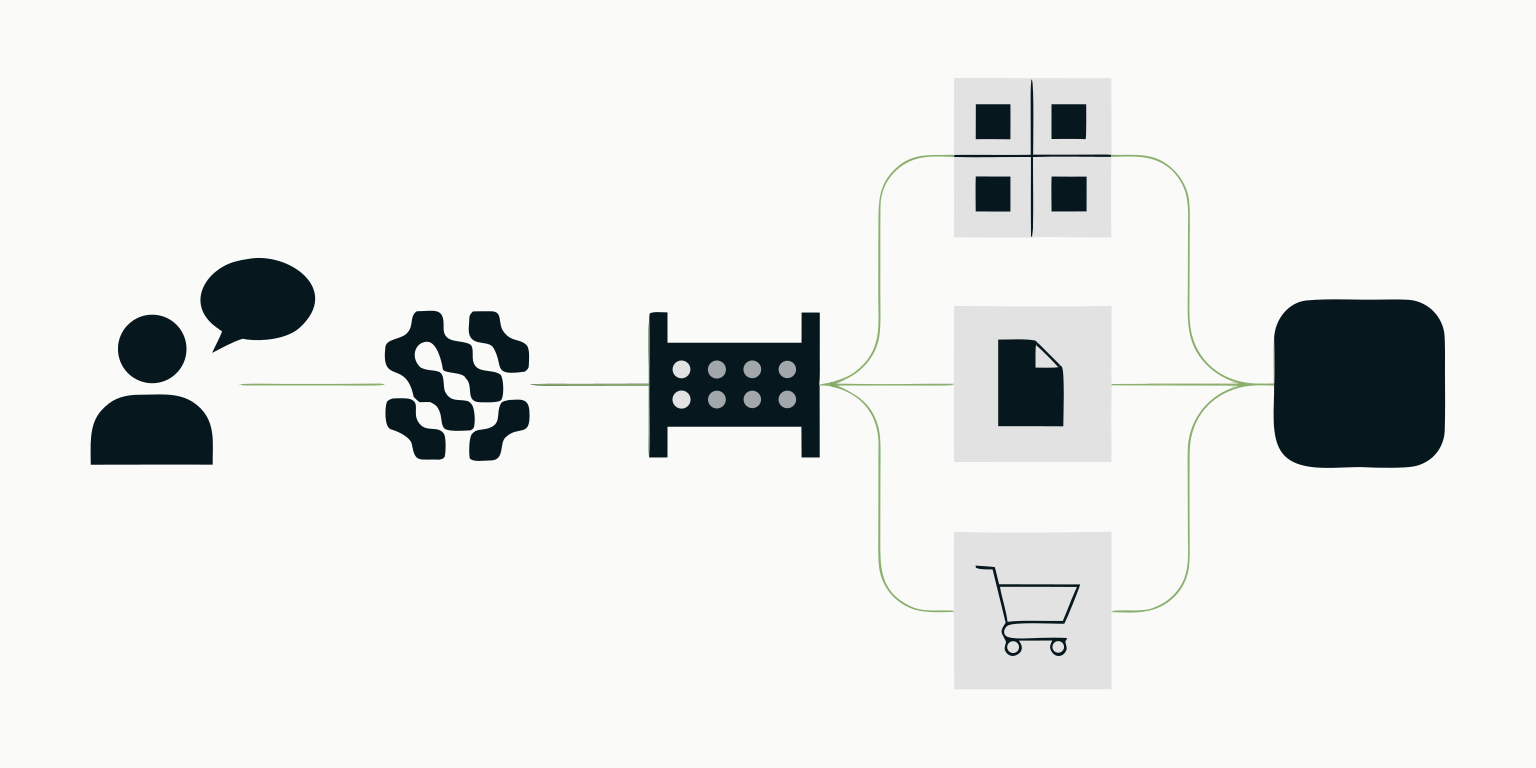
Shopify Storefront MCP gives AI applications a standard way to search a merchant's catalog, retrieve product details, answer policy questions, and support shopping actions with current Shopify data.
The short answer: Storefront MCP is not a chatbot by itself. It is the commerce connection behind a chatbot, shopping assistant, or external AI agent. Shopify hosts the product, policy, and commerce tools; an AI application calls those tools, decides what to say, and presents the experience to the shopper.
For merchants, the most important work is not choosing a language model. It is making sure products, variants, attributes, availability, markets, and policies are complete enough for an agent to represent the store accurately.
MCP and UCP in Plain English
Two acronyms appear throughout Shopify's agentic commerce documentation.
MCP: Model Context Protocol
MCP standardizes how an AI application discovers and calls tools. Instead of writing a different proprietary connector for every model, a developer can connect an MCP-capable agent to tools with defined names, inputs, and outputs.
In this case, the tools expose Shopify commerce capabilities.
UCP: Universal Commerce Protocol
UCP standardizes commerce actions across the buyer journey: product discovery, carts, checkout, and orders.
Shopify's current Catalog MCP tools implement UCP and use the MCP transport. A useful mental model is:
- MCP describes how an agent communicates with tools.
- UCP describes the commerce capabilities and data shapes those tools use.
The protocols solve different parts of the same integration.
What Storefront MCP Can Do
Shopify documents tools across several commerce stages.
Search a store's catalog
search_catalog accepts a natural-language query such as:
A lightweight waterproof jacket for daily cycling in London under £180.
The response can contain matching products, price ranges, media, and variants from the selected merchant.
This is more useful than a basic keyword match when the catalog contains the attributes needed to understand "lightweight," "waterproof," "cycling," and the shopper's market.
Look up a known product
lookup_catalog retrieves products or variants when the agent already has an identifier from a prior search, saved item, or shared link.
Use this to refresh product information instead of trusting a stale answer from conversation history.
Resolve options and variants
get_product returns detailed product information and supports option selection. An agent can help a shopper narrow a product to a valid color, size, or other option while checking whether combinations exist and are available.
Answer policy questions
search_shop_policies_and_faqs can answer questions such as:
- Can I return a sale item?
- How long does delivery take?
- Do you ship to Singapore?
- Is this product covered by a warranty?
The quality of the answer depends on the merchant's published policy and knowledge content.
Work with carts and checkout
Shopify's agentic commerce documentation covers cart construction, localization, checkout handoff, and—at higher trust levels—direct checkout capabilities.
The exact endpoint and tool set is evolving as Shopify moves commerce capabilities toward UCP. Developers should inspect the live server tools and current UCP documentation instead of hardcoding assumptions from an older tutorial.
Support authenticated customers
Shopify also provides a Customer Accounts MCP server for customer-specific actions such as order lookup and account information.
This is a separate, authenticated integration. It requires OAuth 2.0, appropriate access scopes, and Level 2 protected customer data access. A public product assistant does not automatically have permission to read orders or personal information.
The Buyer Journey
A typical store-specific shopping conversation works like this:
- A shopper describes what they need.
- The AI application calls Storefront Catalog MCP.
- Shopify returns matching product data.
- The agent explains suitable options and asks useful follow-up questions.
- The shopper chooses a product and variant.
- The application creates or updates a cart.
- The shopper is handed to Shopify checkout, or an approved trusted agent continues through supported checkout capabilities.
The AI application controls the conversation. Shopify remains the source for products, variants, prices, availability, carts, and checkout.
Storefront Catalog vs Global Catalog
Shopify provides two UCP catalog interfaces.
Storefront Catalog
Storefront Catalog searches within one merchant's store.
Use it when:
- The shopper is already on a brand's storefront
- A brand wants its own AI shopping assistant
- The conversation should only recommend that merchant's products
- Product comparisons happen within one catalog
The documented endpoint is:
https://{storeDomain}/api/ucp/mcpGlobal Catalog
Global Catalog searches across Shopify merchants.
Use it when:
- An agent helps a shopper compare products across brands
- The shopper has not selected a merchant
- Discovery begins with a general product need
The documented endpoint is:
https://catalog.shopify.com/api/ucp/mcpBoth catalog interfaces expose search_catalog, lookup_catalog, and get_product, but their scope and supported extensions differ.
What Is an Agent Profile?
UCP catalog requests include a URL pointing to the agent's profile.
The profile tells Shopify:
- Which agent is making the request
- Which capabilities the agent supports
- How Shopify can verify it
- Which trust tier, rate limits, and tools may apply
An agent profile is not a merchant API password. Shopify's catalog documentation describes profile-based access without an API key for standard access, while higher access and rate limits can require additional approval or authentication.
Developers should treat the profile as part of the agent's identity and capability negotiation, not as a value to copy from an example indefinitely.
What Merchants Get and What Still Needs Building
It helps to separate Shopify infrastructure from the customer experience.
Shopify provides
- Store and global catalog interfaces
- Structured product and variant responses
- Catalog search and product lookup tools
- Cart, checkout, and order capabilities documented through UCP
- Store policy and FAQ retrieval
- Customer account tools with protected access
- Live commerce state from Shopify
The merchant or development team provides
- The customer-facing chat or agent interface
- Model selection and AI orchestration
- Conversation history and application state
- Guardrails and response rules
- Branding, accessibility, and analytics
- Escalation to human support
- Testing against the merchant's real catalog
- Any custom tools outside Shopify's standard capabilities
Storefront MCP does not place a finished AI assistant on the storefront by itself.
Why Product Data Quality Determines Recommendation Quality
An agent cannot reliably infer a fact the catalog never states.
Consider a shopper asking for:
A fragrance-free moisturizer for sensitive skin that is vegan and safe during pregnancy.
If the product title says only "Daily Cream" and those attributes are absent or inconsistently buried in prose, the agent has weak evidence for a recommendation.
Strong catalog data includes:
- Clear product titles
- Specific descriptions
- Shopify taxonomy categories
- Consistent option names
- Unique SKUs and valid identifiers
- Materials or ingredients
- Dimensions, fit, and sizing
- Compatibility
- Certifications
- Intended use
- Care instructions
- Accurate prices and availability
- Useful product media
Store stable facts in consistent product fields and metafields. Do not create a different field name for the same attribute in each collection.
Variants Need More Than a Color Name
Variant quality affects both recommendations and cart accuracy.
Audit:
- Whether every valid option combination exists
- Whether unavailable and nonexistent combinations are distinguished
- Whether SKUs are unique
- Whether prices are correct by variant
- Whether variant images show the selected option
- Whether size labels are consistent
- Whether market availability is accurate
An agent may find the right parent product and still fail the shopper if it cannot resolve a purchasable variant.
Policies Must Be Written for Retrieval
Policy tools work best when the source material contains direct, unambiguous answers.
Weak:
We want every customer to love their purchase. Reach out and our team will see what it can do.
Stronger:
Unworn full-price items can be returned within 30 days of delivery. Sale items are final sale. Customers in the United States receive a prepaid return label.
The stronger version tells a shopper:
- Which products qualify
- The return window
- The start date for that window
- Whether sale items differ
- Who pays return shipping
- Which market the policy applies to
Review shipping, returns, warranties, subscriptions, exchanges, and product-specific exceptions. Keep storefront copy, Shopify settings, structured data, and support answers consistent.
Markets and Localization
An AI shopping experience should not recommend a product based on the wrong market.
Pass relevant buyer context where supported and verify:
- Currency
- Market price
- Product availability
- Shipping destination
- Language
- Duties and tax presentation
- Variant availability
- Checkout localization
Never let a conversational answer override Shopify's current commerce state. The cart and checkout response should remain authoritative for final totals and availability.
Storefront MCP Is Not the Same as Product Schema
Product JSON-LD and Storefront MCP serve related but different channels.
- Product structured data helps web crawlers understand a product page.
- Merchant Center feeds help Google verify and distribute product information.
- Shopify Catalog and MCP tools expose commerce data to agents.
A merchant should maintain all three where relevant. They should agree on product identity, price, availability, brand, images, and variants.
Our Product Schema for Shopify Hydrogen guide covers the web structured-data layer. The Hydrogen AI search audit covers rendering, crawlability, feeds, and technical consistency.
Does a Merchant Need a Custom AI Assistant?
Not every store needs one.
A custom assistant can make sense when
- The catalog is large or technically complex
- Customers need help comparing specifications
- Compatibility determines whether a product works
- Product discovery normally requires several filters
- The store has detailed policies or configuration steps
- Bundles or routines require guided selection
- B2B buyers repeat complex orders
- Support receives the same pre-purchase questions every day
A custom assistant may be premature when
- The catalog has only a few straightforward products
- Product data is incomplete
- Policies are unclear
- The team cannot monitor incorrect answers
- Existing navigation and search have obvious unresolved problems
- The assistant has no job beyond repeating product descriptions
Fix the underlying catalog and storefront first. A conversational interface can make good data easier to use; it cannot turn missing data into trustworthy advice.
For the technical architecture, guardrails, testing plan, and staged rollout, continue with How to Build an AI Shopping Assistant for Shopify.
A Sensible Implementation Architecture
A production storefront assistant usually needs:
- Chat interface — embedded storefront UI with accessible controls and clear loading states.
- Application server — protects model credentials, manages sessions, and enforces rules.
- AI model — understands the shopper's request and decides when to call a tool.
- Shopify MCP client — discovers and invokes catalog, policy, cart, and account tools.
- Conversation store — retains only the context required for a coherent session.
- Analytics — records tool success, failed searches, handoffs, and conversions without exposing sensitive prompts.
- Human escalation — transfers questions the assistant cannot answer safely.
Do not call paid model APIs directly from storefront JavaScript with a secret key.
Guardrails That Matter
An assistant should:
- Use current tool results for price and availability
- Say when information is missing
- Avoid inventing materials, compatibility, delivery dates, or policy exceptions
- Confirm a variant before adding it to cart
- Show the shopper what changed in the cart
- Require authentication before accessing customer data
- Avoid exposing private conversation or account information in analytics
- Offer a human handoff for uncertain or sensitive requests
The most dangerous answer is not an obvious error. It is a confident answer built from incomplete catalog data.
How to Measure Value
Track outcomes, not conversation volume.
Useful measures include:
- Product searches that return no useful result
- Product-detail tool failures
- Variant-selection completion
- Add-to-cart rate after an assisted conversation
- Checkout handoff rate
- Assisted conversion rate
- Support handoff rate
- Repeated unanswered questions
- Revenue by assisted session
- Return or cancellation reasons associated with incorrect recommendations
Review conversation samples with privacy controls. Failed queries often reveal missing product attributes or policy gaps that should be fixed at the source.
Merchant Readiness Checklist
- Products use clear, specific titles
- Descriptions answer real purchase questions
- Taxonomy and product categories are accurate
- Important attributes use consistent fields or metafields
- Variant option names and values are normalized
- SKUs and identifiers are reliable
- Price and availability are current in every market
- Product images clearly show meaningful differences
- Shipping, return, exchange, and warranty policies are explicit
- Storefront, feeds, schema, and Shopify catalog agree
- The team has defined what the assistant may and may not answer
- Customer-specific features use proper authentication
- Human escalation is available
- Analytics measure commercial outcomes and failure modes
Questions to Ask an Implementation Partner
- Which Shopify MCP and UCP capabilities will the assistant use?
- How will the integration adapt when live tool schemas change?
- Which product attributes are missing today?
- How are markets and buyer context handled?
- Where is conversation data stored, and for how long?
- How are model and tool errors shown to shoppers?
- How does a shopper correct or remove a cart item?
- When does the assistant require authentication?
- What happens when the model is uncertain?
- Which metrics prove the assistant is helping?
An implementation proposal should answer these questions before discussing animation, avatars, or the personality of the chat bubble.
Need Help Planning a Shopify AI Shopping Experience?
We build custom Shopify apps, Shopify Hydrogen storefronts, and the product-data foundations they depend on.
If your catalog is ready but product discovery remains difficult, contact Webmakers Studio. We can map the customer questions, Shopify data, MCP tools, guardrails, and measurement plan before deciding whether a custom assistant is justified.